North-Facing Windows: 8 Ways to Brighten a Dim Room
North light has a reputation problem. It arrives cool and even, without the hot patches of sun that make a south-facing room feel generous. Nothing glitters. Nothing throws a dramatic shadow. In a deep room, or one with a hedge and a brick wall outside, the whole space can sit at a permanent four in the afternoon.
But a north-facing room is not automatically a dark room. It is a room with a particular quality of light, and most of what makes it feel gloomy is a decision somebody made: the paint, the curtains, the sofa in front of the glass, the single bulb in the ceiling rose. Change those decisions in a sensible order and the same room reads noticeably brighter, usually without touching the structure. Here are eight fixes, from the free ones to the ones worth saving for.
1. Paint the Walls for Cool Light
North light carries a blue cast, which is why pure brilliant white so often turns to grey on a north wall at ten in the morning. The same light flatters warm whites — bone, almond, soft oatmeal, a white with a drop of ochre or pink in it. Cool greys and blue-based whites, so dependable in a sunny room, go flat and slightly dingy here.
Buy sample pots and paint A3 patches on two walls, then leave them for a week. Look at them at breakfast, at three in the afternoon, and under the lamps in the evening. Manufacturers publish a light reflectance value for every colour; the higher the number, the more light comes back into the room, and the difference between a mid-tone and a pale one is easy to see on the wall.
Two details often get missed. First, the ceiling: a brilliant white ceiling in a dim room reads grey and heavy. A soft white with a warm undertone, or the wall colour a shade lighter, lifts the whole space. Second, sheen. Matte is fashionable but absorbs light; an eggshell on the walls, or satin on the woodwork and skirting, returns a small but real amount of it. If you want a deeper colour, put it on a wall the daylight actually reaches, not on the shadowed wall behind the sofa, where it will turn to mud.
2. Take the Weight off the Window
Curtains and blinds that give light back
Most north rooms lose a surprising amount of glass to their own window dressings. Fix the track so it runs well beyond the frame — 15–20 cm on each side is not extravagant — and mount it close to the ceiling rather than just above the glass. A curtain that covers only the window will always look mean, and it will cut the light again every time it is drawn. When the curtains are open, the whole stack should sit over the wall, not over the glass.
Fabric matters as much as position. Heavy velvet and dark linen are lovely in a room with too much sun; here they behave like a lid. Choose a light-coloured cotton, a fine wool, or a linen blend that still has body but lets some light through the weave. If privacy is the issue, a sheer roller blind in a warm white does more for the room than a heavy curtain half-closed all day. Venetian blinds can be tilted almost flat to the light, and shutters with wide slats do the same job with more furniture-like solidity.
Let the glass do its job
Before buying anything, clean the glass, take down old net curtains, and remove anything stuck to the frame. A north window that has not been washed since the previous owner moved in can be losing a surprising amount of light to a film of city grime. If a valance or pelmet is purely decorative and sits low over the glass, consider taking it down; the difference at midday is often more than a new lamp would make.
3. Put a Mirror Where It Can Work
A mirror does not create light, but it can move what is already there. In a north-facing room, the useful position is usually opposite the window or at right angles to it, where it catches the pale daylight and sends it across the room. A large mirror on the wall beside the window can brighten a dark chimney breast; one opposite the window can double the view and make the room feel less closed in.
Size matters more than frame. A small decorative mirror above a console table does little except decorate the console table. A generous mirror — as tall as the sofa is wide, or as broad as the sideboard beneath it — behaves like a second window. Avoid placing it where it reflects a dark wall, a heavy bookcase, or the back of a television; that is how a mirror makes a room feel smaller rather than lighter.
4. Move the Furniture Out of the Light
The most common cause of a dim north room is a tall piece of furniture standing in front of the best glass. A sofa pushed against the window, a wardrobe on the adjacent wall, a bookcase that blocks the first metre of daylight: these are not decorating mistakes so much as light-blocking decisions. Pull the sofa forward, float it in the room if the space allows, and keep the sill and the first stretch of floor beyond it clear.
Near the window, choose low furniture. A bench, a pair of small chairs, a low sideboard, or a slim desk placed perpendicular to the glass will all leave the light path intact. If you need storage, put it on the wall opposite the window rather than beside it. The aim is not an empty room; it is a room where the eye can still travel from the doorway to the glass without climbing over a dark shape.
5. Lighten the Floor and the Big Surfaces
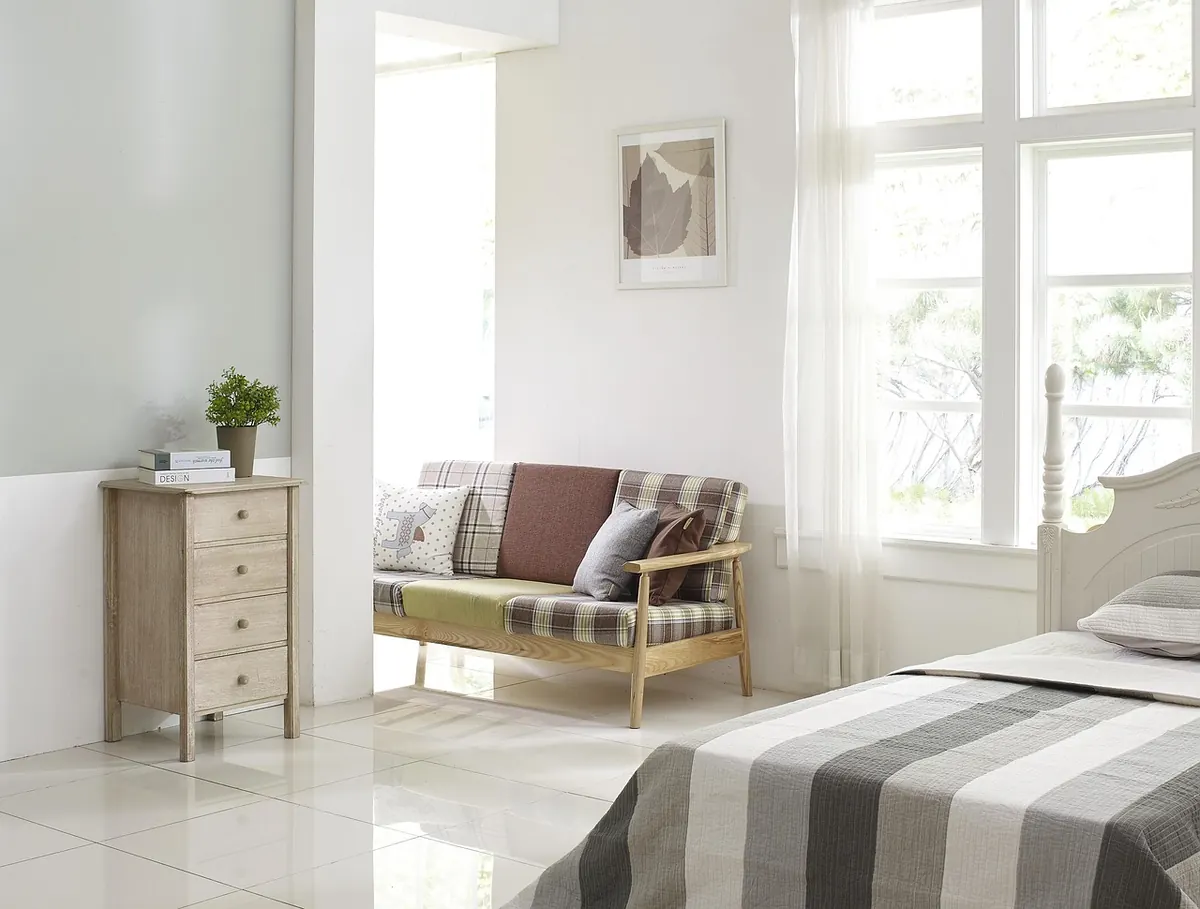
Floors and large upholstered pieces cover more area than most people register, and they set the tone of the room long before the cushions do. A dark oak floor, a brown leather sofa, and a charcoal rug will absorb north light and hold it. A pale oak floor, a warm oatmeal rug, and a sofa in soft linen or a light warm grey will bounce it back. This does not mean an all-white room, which can feel clinical in cool light; it means choosing the lighter version of the colours you already like.
Consider the surface finish as well as the colour. A polished floor, a stone tile with a slight sheen, or a wool rug with a tight weave all return a little light upward. Too much gloss in a north room can look cold, so keep the shine for small areas — a metal lamp base, a glass table, a brass door handle — and let the big surfaces stay soft and pale.
6. Layer the Artificial Light
A single bulb in the centre of the ceiling is the enemy of a north-facing room. It lights the top of the room and leaves the corners to fend for themselves, and in the evening it turns every flaw in the paint into a shadow. Replace the single source with layers: a floor lamp in the dark corner, a table lamp beside the sofa, a wall light where there is no room for a table, and perhaps a picture light over something worth looking at.
Use warm bulbs — around 2700K — and choose a high colour-rendering index so that wood, fabric, and skin do not look grey. Put the lamps on dimmers if you can, so the room can be bright for cleaning and low for the evening without changing the bulbs. Uplighters and lamps with wide shades throw light onto the ceiling and walls, which makes the whole room feel taller and more open than a pool of light on a table ever will.
7. Clear the View Outside
Some of the darkness in a north room is coming from the garden. A hedge that has grown a metre above the sill, a shrub pressed against the glass, a heavy fence close to the window: all of these cut daylight before it ever reaches the room. Cut back what you can, and if the view is still a brick wall, consider whether the boundary could be softened with something paler or lighter in leaf.
Inside, move anything from the windowsill that does not need to be there. A row of tall plants, a stack of books, a collection of jars: each one removes a little more glass. Keep the sill clear or use only low objects, and let the window read as a bright rectangle rather than a shelf with a window behind it.
8. Add Warm Colour and Contrast
A north room needs a little colour to stop it reading as a photograph in fog. Warm accents — terracotta, ochre, rust, coral, aged brass, honey-toned wood — give the cool light something to work against. They do not have to be large. A pair of rust cushions, a warm red rug underfoot, a framed print with a mustard border, a wooden bowl on the table: these small decisions make the room feel inhabited rather than merely lit.
Contrast helps as well. An all-pale room can go flat in north light, so include one or two darker notes — a black lamp base, a deep green plant, a charcoal throw — to give the eye somewhere to rest. The trick is to keep the contrast in the accessories and the smaller surfaces, not in the walls, the sofa, or the curtains, where it will swallow the light you have just worked to protect.
A north-facing room does not need more light so much as fewer things getting in the way of the light it already has.
The Order to Do Things
It is easy to spend money in the wrong order. Start with the free fixes, because they often change the diagnosis. Clean the glass, clear the sill, take down the net curtains, and move the tallest piece of furniture away from the window. Then live in the room for a week before buying paint or lamps.
- Clear and clean the window, and cut back anything outside that blocks the glass.
- Test paint samples on two walls and the ceiling, and look at them at different times of day.
- Plan the artificial light before choosing curtains, so lamps and sockets are where you need them.
- Hang the curtain track wide and high, and choose a light fabric that still gives privacy.
- Move the furniture to keep the path from window to room clear.
- Add a large mirror and a pale rug where they can bounce light rather than absorb it.
- Finish with warm accents and one or two darker notes for contrast.
What Not to Do
- Do not paint everything brilliant white and assume it will solve the problem; in north light it often reads grey.
- Do not hang a small mirror and expect it to behave like a window.
- Do not rely on one ceiling light in the evening, however bright the bulb.
- Do not use heavy dark curtains in a room that already struggles for daylight.
- Do not push tall furniture against the window wall and then wonder why the room feels closed in.
- Do not choose a cool grey scheme just because it looked crisp in a south-facing showroom.
None of these fixes is dramatic on its own. Together they change the way the room behaves: the walls stop swallowing the light, the window gives back more of the glass, the lamps fill the corners, and the warm accents stop the whole space from feeling like a waiting room on a wet Tuesday. A north-facing room will never be a sun trap. It can still be bright, calm, and quietly generous — which is often a better thing to live with.
Photo: manbob86 / Pixabay